|
|
 |
Honduras Travel Information and Hotel Discounts |
|
|
|
|
|
|
| |
 |
|
|
●
Honduras Car Rental SuperSaver ●
 |
|
Major Listings Hotel Lodging
Accommodations in Honduras |
|
|

 |
|
Honduras Hotel Accommodations |
|
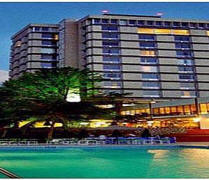
Honduras Maya Hotel
Colonia Palmira Tegucigalpa,
With over 34 years of traditional Honduran hospitality
experience, the Honduras Maya
Hotel and Convention Center has once again been rated the best hotel in
Tegucigalpa (Latin Finance Magazine annual executive
business survey for Latin America Located in the capital
city's exclusive Palmira district, the Honduras Maya Hotel
offers quick and efficient access
to Toncontin International Airport, |
 |
|
|
|
|
|
|
|
|
|
|
3D
Animated Flags--By 3DFlags.com |
Honduras
Find a premier Hotel & Resort at
Hilton Hotels.
or book Sheraton Hotels and Resorts
|
|
|
|
|
|
|
|
The Republic of Honduras is a country in
Central America, bordered to the west by
Guatemala, to the south west by El Salvador, to
the south east by Nicaragua, to the south by the
Pacific Ocean, to the north by the Gulf of
Honduras and the Caribbean Sea, with Belize
(formerly British Honduras) situated 75 km away
across the Gulf of Honduras.
History
Main articles: History of Honduras, Timeline of
Honduran history
The Pre-Columbian city of Copán is a locale in
extreme western Honduras, in the Copán
Department, near to the Guatemalan border. It is
the site of a major Maya kingdom of the Classic
era. The ancient kingdom, named Xukpi
(Corner-Bundle), flourished from the 5th century
AD to the early 9th century, with antecedents
going back to at least the 2nd century AD. The
Maya civilization decayed, and by the time the
Spanish came to Honduras, the once great
city-state of Copán was overrun by the jungle.
After the Spanish discovery and subsequent
conquest, Honduras became part of Spain's vast
empire in the New World. The Spanish ruled
Honduras for approximately 3 centuries.
Honduras became a state in the United Provinces
of Central America in 1821, and an independent
republic with the demise of the union in 1840.
The Football war of 1969 was fought with El
Salvador. It lasted approximately 100 hours.
During the 1980s, Honduras was used as a large
military base of the United States to create,
train and support the anti-Sandinista contras
fighting the Nicaraguan government and to
support the government of El Salvador forces
fighting against the guerrillas trying to oust a
long succession of violently repressive military
dictatorships, and military backed governments.
Hurricane Fifi which caused severe damage took
place around on September 18 and 19, 1974.
Later, Hurricane Mitch devastated the country
and wrecked its economy in 1998.
Geography
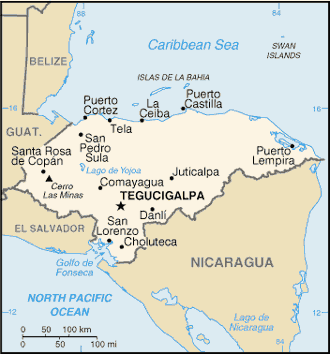
Map of Honduras
Shaded relief map of Honduras, 1985Main article:
Geography of Honduras
Honduras borders the Caribbean Sea on the north
coast and the Pacific Ocean on the south through
the Gulf of Fonseca. The climate varies from
tropical in the lowlands to temperate in the
mountains. The central and southern regions are
relatively hotter and less humid than the
northern coast.
Honduran terrain consists mainly of mountains
(~80%), but there are narrow plains along the
coasts, a large undeveloped lowland jungle La
Mosquitia region in the northeast and the
heavily populated lowland San Pedro Sula valley
in the northwest. In La Mosquitia lies the
UNESCO-protected Biosphere of Río Plátano, with
the Río Negro dividing the country from
Nicaragua. See Rivers of Honduras.
Natural resources include timber, gold, silver,
copper, lead, zinc, iron ore, antimony, coal,
fish, and hydropower.
|
|
|
|
|
|
|
Background:
|
Part of Spain's
vast empire in the New World, Honduras became an independent
nation in 1821. After two and one-half decades of mostly
military rule, a freely elected civilian government came to
power in 1982. During the 1980s, Honduras proved a haven for
anti-Sandinista contras fighting the Marxist Nicaraguan
Government and an ally to Salvadoran Government forces fighting
against leftist guerrillas. The country was devastated by
Hurricane Mitch in 1998, which killed about 5,600 people and
caused almost $1 billion in damage. |
|
Location:
|
Middle America,
bordering the Caribbean Sea, between Guatemala and Nicaragua and
bordering the North Pacific Ocean, between El Salvador and
Nicaragua |
|
Geographic coordinates:
|
15 00 N, 86 30 W
|
|
Map references:
|
Central America
and the Caribbean |
|
Area:
|
total:
112,090 sq km
land: 111,890 sq km
water: 200 sq km |
|
Area - comparative:
|
slightly larger
than Tennessee |
|
Climate:
|
subtropical in
lowlands, temperate in mountains |
|
Terrain:
|
mostly mountains
in interior, narrow coastal plains |
|
Ethnic groups:
|
mestizo (mixed
Amerindian and European) 90%, Amerindian 7%, black 2%, white 1%
|
|
Religions:
|
Roman Catholic
97%, Protestant minority |
|
Languages:
|
Spanish,
Amerindian dialects |
|
Currency:
|
lempira (HNL)
|
|
Currency code:
|
HNL |
|
Exchange rates:
|
lempiras per US
dollar - 16.0256 (January 2002), 15.9197 (2001), 15.1407 (2000),
14.5039 (1999), 13.8076 (1998), 13.0942 (1997) |
|
|
Destination
Guides > South
America > Central
America & Caribbean |
|
|
|
|
|
|



